- Size
- Smallest
- Small
- Small to Medium
- Medium
- Large
- Giant
- Characteristics
- Smartest
- Hypoallergenic
- Fluffy
- Best Guard
- Best Family
- Best for Kids
- Low Shedding
- Healthiest
- Police Dogs
- Most Calm
- Quietest
- Color
- White
- Black
- Grey
- Brown
- Blue
- Red
- Coat
- Hairless
- Short
- Long
- Origin
- Japan
- China
- Australia
- Germany
- Italy
- United States
- France
- Group
- Hound
- Terrier
- Herding
- Toy
- Working
- Sporting
Why Big Dogs Age Faster: The Truth About Joint Health and How to Protect Your Best Friend
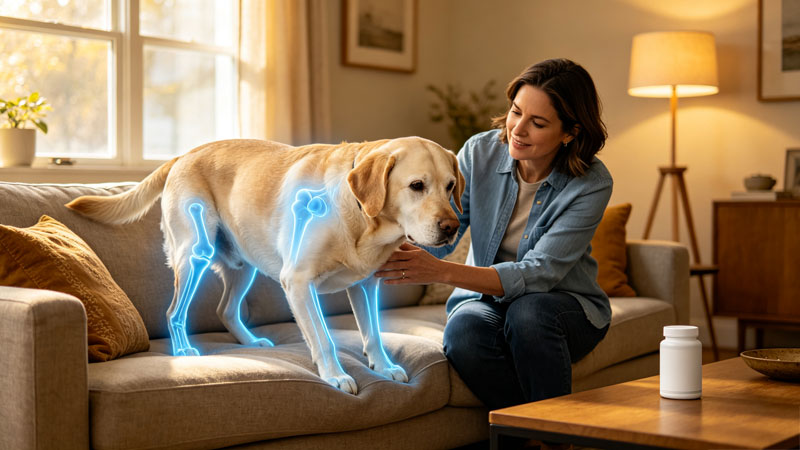
Image generated by AI
If you’ve shared your life with a large or giant breed, you’ve likely noticed a sobering reality: your dog’s joints don't seem to age at the same pace as their spirit. While a small-breed dog might stay spry and agile well into their golden years, many giant breeds—like Great Danes—are considered “seniors” by age six.
Genetics definitely play a role, but the real wear and tear usually comes down to the physics of body mass, the grind of daily activity, and the natural decline of connective tissue. Understanding the “why” behind this early decline is the first step in taking control of your dog’s long-term mobility.
The Physics of Being Big: Why Joints Break Down
Every time your dog jumps for a ball or bounds out of the car, their hips, elbows, and knees are absorbing a massive amount of kinetic force. For a small dog, this is barely a blip on the radar. For a 100-pound dog, it’s a constant, repetitive stress test on their cartilage.
Think of cartilage as the “shock absorbers” of the skeletal system. In a young dog, the body is a pro at repairing minor wear and tear. But as they age, that repair process slows down significantly. In large breeds, the rate of damage quickly outpaces the body’s ability to rebuild. By the time you notice a limp, the issue is often far more than just a passing ache—it’s the result of years of cumulative mechanical stress.
The takeaway? Prevention isn’t just a good idea; for big breeds, it’s a necessity. It is exponentially easier to support healthy joints than it is to treat chronic arthritis later on.
The “Genetic Reality” vs. Proactive Care
We all know the usual suspects: German Shepherds are prone to hip and elbow dysplasia, while retrievers often pay the price for a lifetime of high-energy play. Giant breeds—Rottweilers, Bernese Mountain Dogs, Saint Bernards—carry the heaviest load of all, with their large frame putting continuous pressure on developing and aging joints.
But here is the empowering truth: Predisposition is not destiny. Responsible breeding, keeping your dog lean, controlling their growth rates as puppies, and staying on top of routine veterinary care can be absolute game-changers for avoiding early mobility issues.
Collagen: The Building Blocks of Mobility
When we talk about joint health, we’re really talking about cartilage, tendons, and ligaments. These critical connective tissues rely heavily on Type II Collagen to stay flexible, sturdy, and resilient through daily movement.
As your dog ages, their natural collagen production naturally dips and slows. When that vital protein supply runs low, cartilage gradually thins, protective joint cushioning disappears, and your dog’s once-smooth, effortless movement starts to feel stiff and “rusty”.
This is exactly why liquid collagen for dogs has become a go-to staple for owners of aging large breeds. It’s not a magic bullet that fixes existing joint problems overnight, but it serves as a vital piece of your dog’s wellness puzzle — a convenient, targeted nutritional top-up that fuels the body’s natural tissue repair process and sustains long-term joint comfort and flexibility.
Spotting the “Subtle” Red Flags
Dogs are instinctive experts at hiding pain, a survival trait that masks joint damage until conditions become advanced and difficult to reverse. By the time they’re visibly limping, they’ve often been quietly coping with persistent discomfort for months. Watch for these early, easy-to-miss warning signs:
● The “Startup” Stiff: Taking a few clumsy, rigid steps right after a nap or long rest
● The Hesitation: Sudden reluctance to jump into the car, onto furniture, or elevated surfaces
● The Stairs Struggle: Showing obvious hesitation or slowness on stairs they once climbed effortlessly
● The “Energy Dip”: Losing enthusiasm for long walks, fetch, and regular play sessions
● Post-Exercise Stiffness: Tightness and reduced movement after moderate activity
If you notice these small shifts, don’t wait for them to “walk it off”. Check in with your vet promptly. Catching joint decline early is the best way to stop a minor, manageable issue from turning into chronic, life-altering mobility loss.
The #1 Joint Saver: Weight Management
If you take away one thing from this article, let it be this: There is no supplement in the world that can fully reverse the joint damage caused by excess body weight.
Even a few extra pounds put an incredible amount of continuous strain on a large dog’s hips, knees, and elbows with every single step. Keeping your dog at a healthy, lean body weight is the single most effective, evidence-backed way to protect their joints long-term.
For aging large breeds, swap high-impact running, jumping, and rough play for gentle, low-impact activities. Swimming and slow, steady controlled walks build supporting muscle strength and keep joints flexible without punishing worn cartilage.
Choosing the Right Collagen Support

Not all collagen supplements are created equal, and low-quality formulas offer little to no benefit for joint health. When shopping for a reliable product for your large breed, prioritize these key markers:
● Hydrolyzed Collagen: Broken-down, small molecular structure that’s highly bioavailable and easy for dogs’ bodies to absorb and utilize
● Undenatured Type II Collagen (UC-II): The exact collagen type naturally found in canine joint cartilage, targeted to support cartilage structure and flexibility
● Third-Party Testing: Independent lab verification for purity, potency, and safety—never rely solely on brand label claims. Always check the label for a clean ingredient list, too; if you see unnecessary fillers, artificial colors, or questionable preservatives, keep looking. Quality counts.
A critical reality check: Liquid collagen for dogs serves only as a supportive nutritional wellness tool, never a replacement for professional veterinary diagnosis or treatment. Always consult your veterinarian to build a personalized, comprehensive joint mobility strategy tailored to your dog’s unique age, breed, weight, and medical history.
Holistic Daily Practices to Preserve Mobility
Collagen supplementation works best as one part of a complete joint care routine. Pair nutritional support with these daily habits to protect your large breed’s long-term mobility:
● Maintain a consistent lean body weight year-round
● Feed balanced, high-quality nutrition tailored to their age and breed size
● Stick to gentle, regular low-impact exercise
● Limit excessive high-impact activity during puppy growth spurts to prevent developmental joint stress
● Schedule annual vet wellness exams with dedicated joint health screenings for seniors
● Provide soft, supportive bedding to reduce overnight joint pressure
● Consistently monitor movement and behavior changes for early red flags
When to Seek Veterinary Care
Mild, occasional stiffness can come with normal aging, but persistent symptoms demand professional attention. Always consult your vet right away for ongoing limping, visible joint swelling, obvious pain, or sudden difficulty walking and moving normally. These symptoms can signal arthritis, dysplasia, injury, or other treatable joint conditions.
Your veterinarian will help you combine lifestyle adjustments, nutritional support, and targeted treatment to keep your dog comfortable and mobile for as long as possible.
The Bottom Line
Let’s be honest: our big dogs give us their whole hearts, often without a second thought. They’re our constant companions on long road trips and our favorite weighted blankets on the couch. Because they give so much of themselves, they deserve the very best in return—especially when it comes to their comfort.
Their size comes with its own unique set of challenges, but it doesn’t mean we have to sit back and watch them slow down. By staying a few steps ahead—keeping them at a healthy weight, choosing low-impact play, and filling those nutritional gaps with targeted support like collagen—we can give them the gift of moving through their golden years with ease.
They bring the big, loyal spirit and the endless love. All we have to bring to the table is a little bit of extra care and strategy. Let’s make sure they keep wagging their tails and moving happily, pain-free, for every possible year we have with them.
You May Also Like
 Dog HealthBest Veterinary Care for Big Dogs: What Owners Should Prioritize
 Dog HealthHow Long Do Dogs Live With Encephalitis?
 Dog Toys & Puppy ToysThe 5 Best Puzzle Toys For Large Dogs (2022)
 Help & AdviceThese 10 Dog Breeds Novice The Best Not To Keep!
 Breed ComparisonBelgian Malinois vs. German Shepherd: Which Is Better?
 Breed ComparisonDoberman vs. Rottweiler: Which Is the Better Guard Dog?